

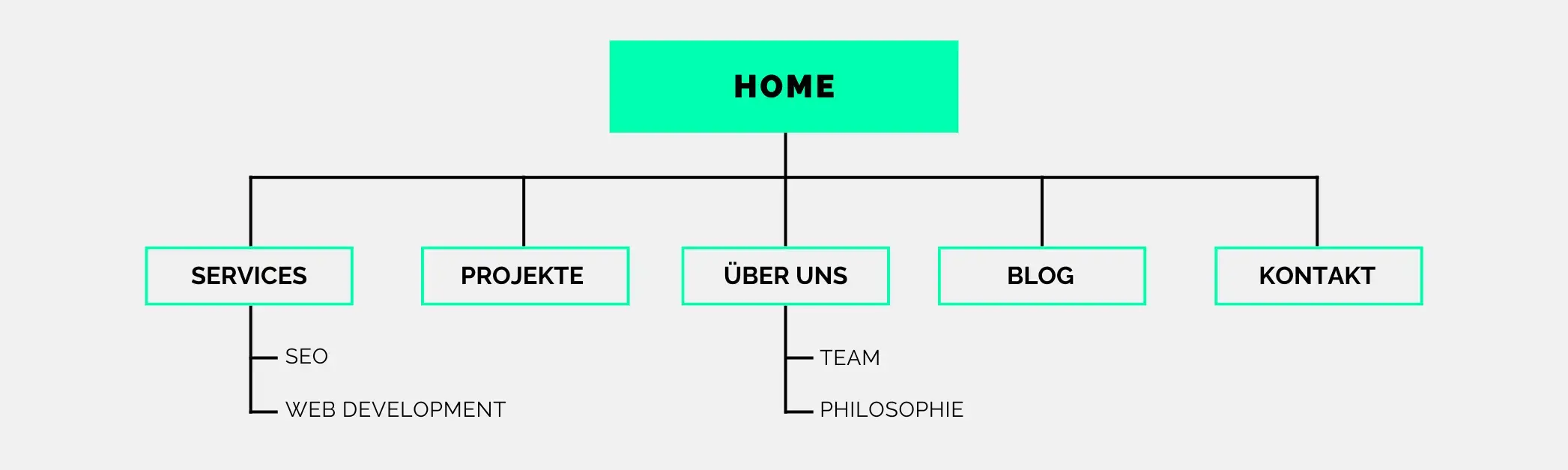
The sitemap plays a central role here. In this article, ONELINE explains how sitemaps work and why professional web development cannot do without them.
What exactly is a sitemap?
The sitemap is a “map” of the website. It is a list that can be generated automatically with the help of the right tools. The sitemap contains all the content of your website, for example a structured list of all subpages.
The creation of lists can help both human viewers and search engines such as Google. With clever menu navigation and an intelligent website structure, human users will be able to manage without such lists. For a well thought-out search engine optimization and a better understanding of the website by Google or Bing, the creation of a sitemap is nevertheless advisable.
Understanding crawling and indexing by Google
In order for your website to be found by Google or other search engines, you need to be included in the search engine index. The indexing process is triggered by regular crawling. In this process, search engine bots systematically search all accessible IP addresses for old and new content.
If your website with all its subpages and other content is recorded, this initially represents an unstructured wealth of data for search engines. You can bring structure to this chaos with a sitemap. If you create suitable sitemaps, Google can access structured and data-based information in addition to the actual content. The search engine thus better understands how the page content is connected. This improved crawling influences the evaluation of the quality and relevance of your website, so you can hope for better search engine positions right from the start.
What is the difference between XML and HTML sitemaps?
When you create your website, you have a choice of different formats and contents for sitemap creation. In addition to a list of subpages as a website structure, lists can be created for images and other media. Whether this is worthwhile depends on the scope of the media elements. If in doubt, these special sitemaps should be created to support the structuring of the page.
There are two different data formats and they should not be confused with each other:
- Created as an XML file, the lists are primarily used for search engine optimization and facilitate indexing by Google. For modern web development and strong SEO, you should definitely rely on lists in this format.
- As an HTML file, a list of subpages and other content is more useful for the human lister. For example, they can call up the file as a separate subpage to get an overview of the structure and access individual content more quickly.
This distinction also means that simply creating an HTML file with all subpages or media elements on the server has little or no impact on SEO. This requires the XML file, which search engine crawlers explicitly search for as a data format for indexing.
The sitemap as part of your SEO strategy
Is it worth creating sitemaps in XML format to boost your rankings on Google and other search engines? In principle, yes. For example, you can find information in the Google Search Console that the lists can improve the crawling of the website. The wording has been carefully chosen so as not to give the impression that the XML files guarantee top rankings.
However, Google indirectly admits that sitemaps are desirable and can have a positive effect on indexing. As an online marketing agency, ONELINE also knows this from experience and advises web developers to place suitable sitemaps on the web server.
In addition to the one-off creation, it is also advisable to regularly update all created files. Especially in online stores or on websites where new content is constantly being added, the familiar structure can quickly become outdated. Thanks to simple software tools, the sitemap can be created in just a few clicks. All the site operator has to do is replace the files on the server.
Are sitemaps essential for top rankings on Google?
Google, Bing & Co. advise the creation of sitemaps for indexing without giving a guarantee for top rankings. What applies in the opposite situation? Is it possible to achieve top positions for search queries if no XML files have been created for structuring? Again, yes, but it depends on the individual case.
A typical example is small websites or one-pagers that have a compact structure. If only a few images and other media elements are used, structuring may not be necessary. If the content is nevertheless of high quality and optimized for specific search terms, top rankings can still be achieved.
In case of doubt, creating a sitemap is always better than not doing so. As small as the website is, Google understands the structure of the page and the media used better. However, missing maps are not an exclusion criterion for top positions.
Is the subsequent creation of sitemaps worthwhile?
Definitely yes. The reason for this is simple: many websites are constantly changing, subpages are deleted or new ones are added. And Google repeatedly sends crawlers to websites that have already been indexed in order to record changes and fill the search results with the latest available content.
If a sitemap structure was previously missing, it can be added as an XML file at any time. The next time Google crawls the site, it will capture and index the page even more intelligently than before. As a web development and SEO agency, ONELINE is also familiar with cases in which the addition of lists has improved the ranking of an otherwise barely changed page.
Conclusion on the sitemap in web development
Whenever you create a website and aim for high Google positions, sitemap creation should not be missing. The lists are created with just a few clicks thanks to clever tools and are simply stored on the server. As an SEO measure, it is one of many pieces of the puzzle of how you can get the best out of your rankings. The online marketing agency ONELINE will be happy to advise you on this topic for your optimal website performance.