
What do HTML, CSS and Java stand for in web development?
The distribution of tasks of the three basic elements HTML, CSS and JavaScript in web development is very clear: HTML provides the structure of a website and is important for handling the content. CSS takes care of the web design – it is responsible for how the contents of a website look. Last but not least, JavaScript is responsible for the behaviour of the individual components of a website and for all interaction components.
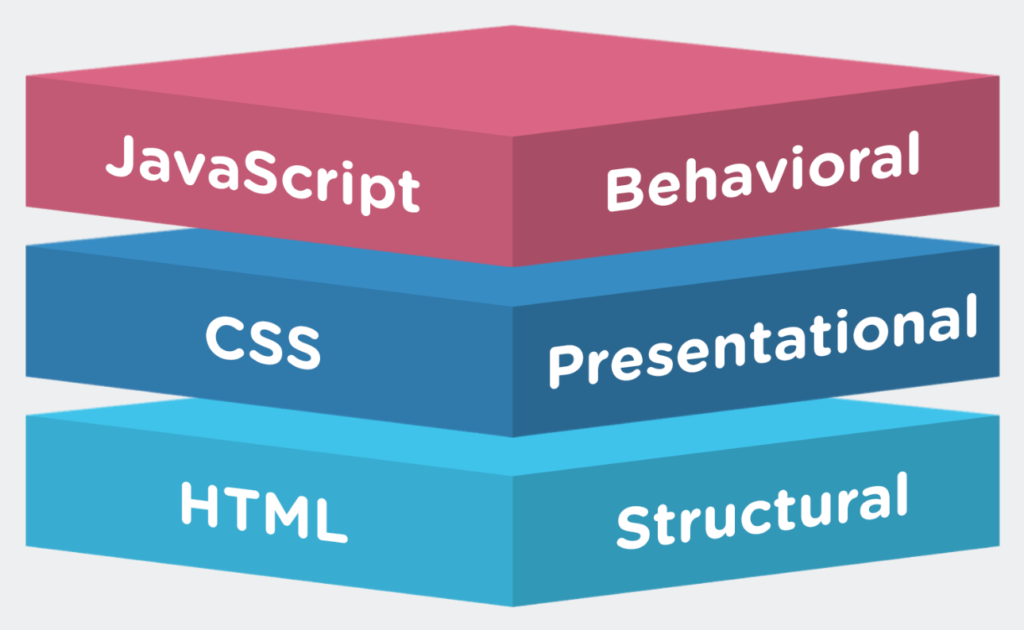
In detail, the three components of web design stand for the following aspects:
• HTML = structure and content
• CSS = Design
• JavaScript = Behaviour
Since none of these aspects is dispensable, modern web development cannot do without any of these basic programming languages. It goes without saying that ONELINE‘s developers are always up to date on the potential and use of the three elements HTML, CSS and Java. After all, programming languages are constantly evolving.
HTML – structure and content of a website
HTML is an abbreviation for Hypertext Markup Language. The HTML code forms the skeleton of a website, so to speak. The main elements of HTML are tags, elements and attributes. The individual elements and building blocks of a website are defined in HTML programming. The respective types of the individual elements and the structure are also defined in HTML.
An HTML document is created as a text file whose extension is .htm or .html. To create the structure of a web page in HTML, developers use basic commands.
HTML is important for integrating and managing paragraphs, headlines, listings and image content on web pages, among other things.
CSS – Design of the website
The abbreviation CSS stands for Cascading Style Sheets. CSS is important as an element of web development because it can be used to determine the appearance and positioning of the individual components of a website. CSS is therefore essential for the layout of a website – it puts the structure given by HTML into a user-friendly form.
The elements that are defined and designed in CSS are, for example, fonts, colours, font sizes and so on. The developers work for this in CSS files in which they specify the individual values. These are text files with programming code in which the required values are entered at the right places.
JavaScript – Movement and interaction on the website
Started as a scripting language for creating pop-ups, JavaScript has now developed into the ultimate tool for complex dynamic and animation control on websites. Everything that can somehow move and change on a website is controlled by JavaScript: from pop-ups to auto-complete functions to browser games, JavaScript controls all the processes and functions of a website.
The programming language is also essential for creating visitor statistics, which are indispensable for the search engine optimisation of a website. In addition, there are functionalities such as playing a preview when the mouse pointer is moved over a video. Slideshows, which are a basic building block for many websites today, are controlled by JavaScript.
The range of functions that can be designed with JavaScript is therefore enormous:
- Pop-ups (for example chat windows, sales notices, etc.)
- Animations, e.g. flashing buttons
- Browser games
- Auto-complete function
- Hovering functions
- Slideshows
- and much more.
How does the interaction of HTML, CSS and Java work?

A website gets its structure and content from HTML, is designed using CSS and the behaviour of the individual components is controlled by JavaScript. In order for all this to work together and to create a functional and appealing frontend for the viewer, another building block is necessary: the browser.
Browsers such as Firefox, Chrome or Edge translate the instructions given in HTML, CSS or JavaScript into applications. To ensure that a page is displayed and functions as desired on all browsers, the corresponding connections must be created in web development. In this process, development is oriented towards common standards.
Functional example for the combination of HTML, CSS and Java
To illustrate the whole thing with an example, please imagine a simple shop page, for example a fashion shop. There, the visitor is greeted directly on the start page with a pop-up that reads “20 % discount for new customers”. This pop-up is JavaScript, as is the chatbot embedded on the page.
When the user clicks on the collection and browses through the assortment, he encounters HTML for all content: product photos, price information and product descriptions – the entire content is based on HTML.
CSS, on the other hand, ensures that the user can find his way around the shop at all in view of the huge assortment – because CSS in web design ensures that a user-friendly interface is created. The arrangement of the product image in relation to the product description and the “Buy” button, the colour and size of the fonts on each page: these are all aspects that are determined via CSS.
This example shows that all three elements are indispensable for creating a functional website. Without HTML, there would be an empty page. And without CSS, the page would be an impenetrable jungle of content building blocks. Without JavaScript, on the other hand, many of the functionalities that users expect today would not be possible.
It is therefore the interaction of HTML, CSS and JavaScript in web development that ensures high-quality, user- and SEO-friendly websites. ONELINE will be happy to advise you on all questions concerning web design.