


What is the importance of display marketing for companies?
According to Statista, 96% of the Swiss population use the Internet. Thus, only 1 in 10 people is not online. Despite the many visual stimuli we encounter every day, the World Wide Web is gaining in importance for advertisers every day. As the amount of time users spend on the web is also growing continuously, online marketers have discovered the best way to reach their target audience is with good placements. Display marketing stands out and encourages clicks – if it’s done well.
What is display marketing?
There is no such thing as display advertising – on the contrary. From online banners in various formats to varying content, display marketing encompasses a fascinating range of possibilities. In fact, the idea of a standardized form exists, however, the majority of publishers do not use it. There are hardly any limits to the freedom of creatives when developing banners, skyscrapers or rectangles. Display ads consist of images or videos in combination with text elements or graphic elements. These online ads are clickable and direct the user to a landing page or to the sender’s homepage. The static or animated banners are placed on interesting websites. Depending on the targeting, the online marketing agency selects relevant pages for this.
Where is display marketing seen and by whom?
The placement of a display medium depends on the sender’s objective and strategy. ONELINE chooses the optimal campaign setup for each partner to ensure maximum success. As a global player, Google dominates the marketing scene; via Google Ads, banners are made available that publishers embed on their website via Google AdSense. Affiliate networks are another option. In this strategy, too, display ads are integrated on interesting websites. In contrast to the advertising network, with affiliates the publishers are responsible and receive their commission on a successful lead.
The techniques for display campaigns are based on the advertiser’s goals. In Real Time Bidding, placements are awarded via an auction. Performance marketing uses various measures and optimizes the media used in the course of the campaign to achieve the best possible results. Depending on the click behavior, Behaviour Targeting adapts the display ad to the user behavior and is thus oriented to the wishes and search of the potential customer. Contextual targeting works in a similar way, where the connection between content and advertising content counts. These meaning-related partnerships can be, for example, children’s clothing and toys, car accessories and a car wash, or travel and summer clothing or suitcases. In programmatic advertising, playout is automated based on user tracking.
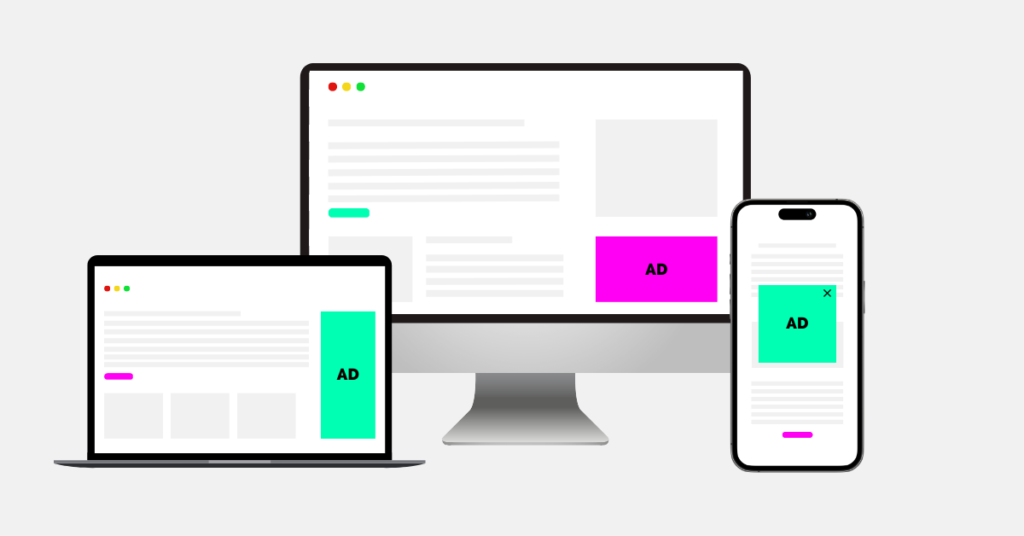
These formats stand out in display marketing
The different formats depend on the technology used, the publisher’s capabilities and the content. Depending on the meaning and content, these formats catch the eye of users:
- static or animated banner ads
- interstitials
- pop-ups
- video ads
- Text links
- sponsored content
Banner advertising on the Internet is one of the most widespread formats. From rectangles to skyscrapers, full-size banners or leaderboards, there is a wide range of sizes and formats. For the design of the banner, all elements that the layout portfolio offers come into question: Images, graphics, animation, moving image, typo and a link.
A sub-form of the banner are interstitials and pop-ups. While pop-ups cover the page and can only be closed again with a click, interstitials take up an entire page. They are very popular with daily newspapers or magazines, for example.
Youtube Ads can be part of a banner ad, appear as a stand-alone video upfront or as an interruption to other video formats. A well-known example is advertising interruptions on YouTube.
Sponsored content aka native advertising is similar in layout and tone to the publisher’s content and is thus perceived by the user as editorial input.
Advantages of display campaigns
Marketing as a whole is becoming increasingly digital, and one of the most important advantages of display marketing campaigns lies in their wide reach. The different formats and placements enable companies and online marketing agencies to design and place campaigns in a targeted manner and in the sender’s CI. In fact, different target groups can be identified and addressed for the same product in a way that is appropriate for the target group. Tracking via cookies and pixels make it possible to address the user again and thus encourage him to buy – remarketing makes it possible. In contrast to print advertising, display campaigns with their extensive analysis options also convince skeptics.
Display campaigns in the marketing mix
In recent years, online marketing has become the most important building block in the marketing mix – and the numbers continue to rise. Depending on the industry and product, analog forms of advertising such as postal mailings still have their place. But the share of digital media in companies’ marketing planning is on the rise and should be an integral part.
Display marketing: mobile or desktop?
Display marketing can be optimized for all devices and therefore plays a role both for mobile and for users of tablets, laptops or desktops. Since the formats are usually played out in a responsive manner, they can be used on all devices. Mobile devices are popular with advertisers because the number of users is continuously growing. Moreover, the high accessibility offers an effective advantage. While a few years ago users liked to get information on their smartphones but made purchases on their desktops, this behavior has changed with mobile payment features. As a result, display marketing has also become more important on mobile devices.