


What makes an accessible website?
An accessible website meets the expectations of the target audience in terms of its design and functionality. Although the details must always be tailored to the individual case, there are some basic factors.
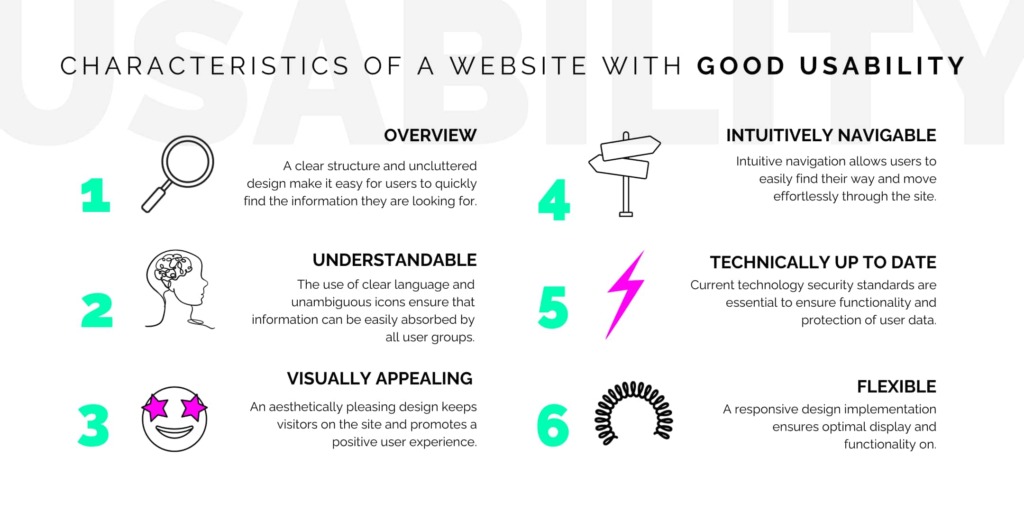
Characteristics of a website with good usability:
- clear
- understandable
- visually appealing
- intuitively navigable
- technically up to date
- flexible with regard to the end device used
- barrier-free
Usability – i.e. user-friendliness – should not be confused with user experience. The latter is also called user experience and describes the subjective experience a person has when visiting a website.
Despite their different focuses, both aspects are crucial for successful online marketing in the long term.
The 7 pillars of an accessible website from the perspective of an online marketing agency
Good usability excites people and search engines alike. Investing in the necessary optimizations is therefore worthwhile. The following points illustrate the supporting pillars of an accessible website.
1. A unique but unobtrusive design
The first impression decides whether a visitor stays on the website or immediately bounces off again. In these crucial moments, it is essential to convince with a well-structured layout and an appealing color design.
Professional web design does not only serve cosmetic purposes – it forms the basis for the content design. The overall look of the site should match the brand identity and meet the aesthetic demands of the target customers.
Even with this first pillar, it is advisable to ensure accessibility. This will allow people with visual impairments to use the website without any problems. For example, contrasts should be used to make text content stand out clearly from design elements.
2. An intuitive navigation
An accessible website provides users with the information they are looking for – quickly and easily. For this, a well thought-out menu navigation and a search function are indispensable.
A prominently placed main menu on the home page gives visitors a first impression of the site’s content structure. Even with extensive websites, it should consist of a maximum of six to ten elements.
Users must be able to understand at first glance what is hidden behind the individual menu items. The same applies to symbols used. The safest way is to choose commonly known symbols – like the magnifying glass for the search bar.
3. A common thread as the DNA of the website
The goal of usability optimization is to increase the user-friendliness of the website and thus gain the trust of visitors. If these efforts are only visible on the home page, the measure misses its target.
It is necessary to make all areas of the site accessible. In this way, a common thread is created that gives users a smooth visit throughout.
4. Clearly structured, readable content
Target group-relevant content with added value is one of the main pillars for success in digital marketing. It keeps the interest of the target customers and contributes to a front positioning on the search results page of Google and Co.
In terms of usability, it is important to prepare the website content clearly. Short paragraphs, meaningful headlines and visual highlights help readers to absorb the content effortlessly.
Making use of the numerous formatting options is not advisable. It is better to use the same font and font size throughout the page.
Effective online marketing requires a holistic strategy and ongoing optimization. For many companies, this is almost impossible to achieve alongside their day-to-day business. As a digital marketing agency, ONELINE creates a user and search engine friendly website for interested partners from all business areas.
5. Sensible use of multimedia content
The aforementioned pillar also includes enriching the content with multimedia content. The challenge is to find a balance between text and visual content.
A user-friendly website guarantees trouble-free access for all target group members. In connection with images, videos and animations, accessibility must thus be included once again.
One helpful factor, for example, is alternative texts – also called alt texts. They enable screen readers to reproduce the content of photos for visually impaired people.
6. Short loading times
How accessible a website is depends largely on its technical functionality. Well thought-out menu navigation and an appealing design are of little use if they are not displayed properly to visitors.
Fast loading times are a basic requirement for good usability. They allow users to access the site’s content without delay. At the same time, the loading time of a website is a ranking factor for search engines. It therefore pays off twice over to keep them as short as possible.
7. A responsive, mobile-friendly theme
The desktop PC is no longer the only device users use for Internet searches. Nowadays, people surf on the go – with a smartphone, notebook or tablet.
A responsive website adapts to the visitor’s surfing behavior and thus ensures optimal accessibility on any end device. The extent to which this flexibility is provided is already determined by the choice of theme in the design phase.
The responsiveness of a website is also a ranking factor for Google. This shows how good usability simultaneously boosts the success of search engine optimization (SEO).
Online marketing success stands and falls with the accessibility of the website
Newsletter registration, product purchase, booking – every professional website serves to persuade visitors to take a certain action. As different as the goals of the providers are: In any case, the accessibility of the website is an important success factor.
Good usability encourages visitors to linger and increases the chance that they will return regularly. Accessible websites are characterized, among other things, by short loading times, a responsive design and a sensible structure.
Google includes these aspects in the ranking, so that the user-friendliness of a website also influences its positioning in the search results. It is therefore all the more important to implement the aforementioned seven tips with the support of a specialized online marketing agency like ONELINE.