

Google’s web crawler indexes not only the content (content/text) of a page but also the URL, which ideally contains one or more keywords. A so-called talking URL could be structured as follows, for example:
webdesign-and-seo-out-of-zurich-services.html (example for the fictitious page “Services”)
In addition to the word services, this URL also contains two keywords (web design, SEO) as well as the company’s headquarters (Erfurt) and is thus indexed accordingly by Google. With this optimisation, too, care should be taken to ensure that the keywords on the respective page are appropriate.
Search engine friendly redirection
You have decided on a new domain and would like to redirect the old page to the new domain? Please note the search engine friendly redirection or the 301 redirect code. This code ensures that the ranking of your homepage on Google is maintained and the Pagerank is transferred.
Paste the following PHP code into the page/file on your old domain:
Please add https://www.neue-domain.de.
Important: The file on your previous domain must have the file extension *.php. If necessary, change the file index.html to index.php and then delete the file index.html.
In order for Google to redirect your old pages to the new pages, it is necessary to tell Google that the old file (e.g. index.html) is still (fictitiously) accessible.
Therefore, create a file with the file name .htaccess. Now insert the following code into this file:
RewriteEngine on
RewriteRule index.html$ index.php
Now Google is advised to fall back on the (new) index.php file when calling up the now (fictitious) index.html file. Since the index.php contains the forwarding to the new domain, from now on only the contents on the new domain (www.neue-domain.de/index.html) will be indexed!
Choice of domain name
The name of the domain can make an essential contribution to your website being indexed more quickly and ultimately being rated positively by Google. The following factors are decisive for this:
- The domain name contains an important keyword that fits the theme of your website and also appears more frequently on the homepage, in the meta description and in the meta title.
- The domain name is short and concise. Of course, this principle applies to visitors and not to bots. Because this makes the domain easy to remember and the potential visitor will come back (= this in turn is important for Google!).
- The domain name does not contain hyphens, unless it is a question of two words which are connected to each other (in terms of content). Three examples are given below:
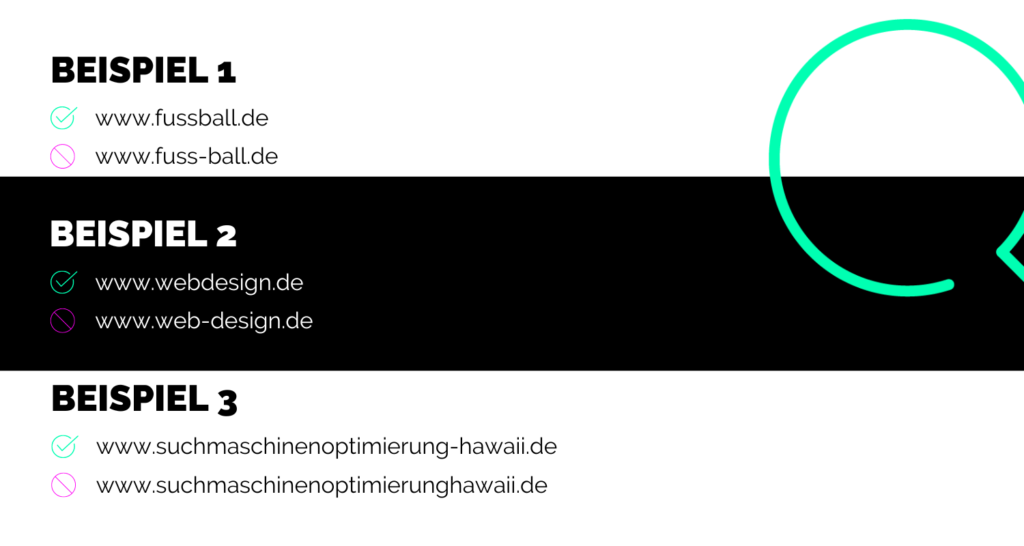
Of course, a good ranking is also possible with a unique or individual domain name – see Facebook.com and Twitter.com. If the supply and demand are right, these domains will also be found in the top positions on Google in the long term. The importance of topic-relevant words within the domain name has decreased in recent years, but can be significant – especially with regard to newly registered domains!
Usability factors for increased SEO success
The topic of usability/user-friendliness is therefore not only important for the user, but also for Google and should always be in the foreground alongside the implementation of SEO OnPage measures. By usability, I refer to the following factors:
- short loading times
- mobile-friendly (Responsive Design or mobile website)
- pleasant font size
- understandable link texts
- excellent internal link structure
- meaningful titles and headings
- captions – keyword accessibility!
- as few or no advertisements as possible
- very good spelling and grammar
Actually, one should assume that most web workers put these factors on the agenda when building a website. Who would want to negligently scare away future users? Even though I and many other website operators take these things for granted, there are still many webmasters who don’t place much value on these essential factors.