
Artificial intelligence (AI) has become part of not only our professional lives, but for some people even their personal everyday lives. What we used to ask other people, we now type into Google – and now various AI systems are available to answer our questions. And this technology doesn’t stop at image generation: the internet is now full of artificially generated images. These are not just unrealistic or surreal representations, such as unicorns licking ice cream on skateboards. They also include realistic-looking portraits of people and landscape images.

How does AI-supported image generation work?
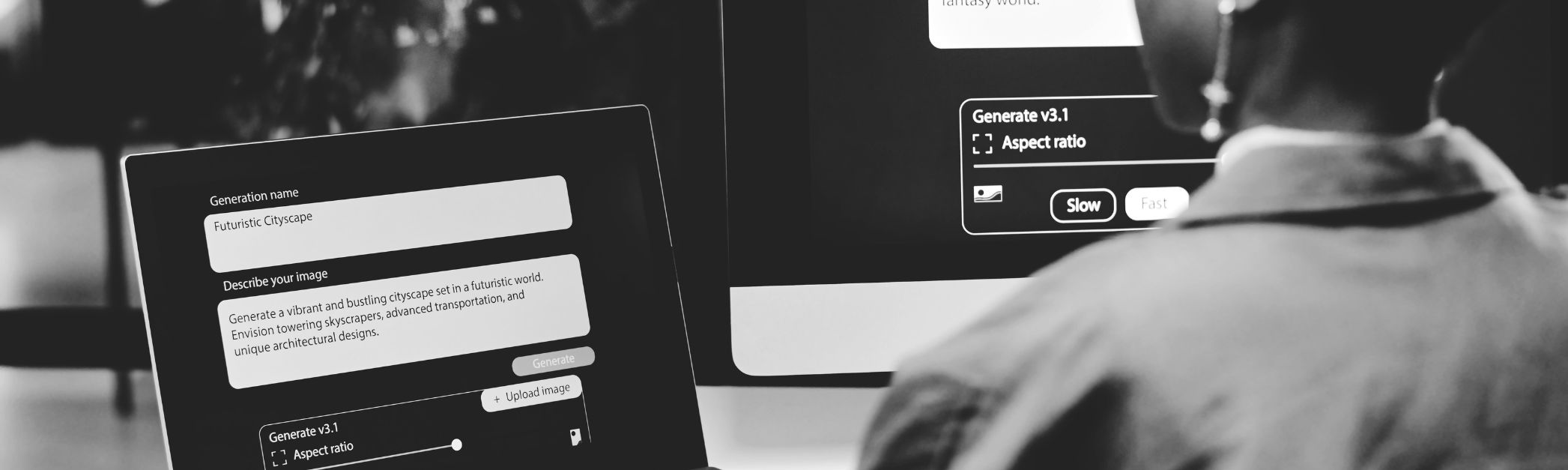
Most people are probably aware that image generation using AI exists. But how do programs like this actually work? Similar to chatbots, which can simulate conversations and answer questions, an AI image generator produces its results based on so-called prompts. The more precise these text descriptions are, the more accurate the result will be. They can also edit existing images as desired. AI image generators rely on generative adversarial networks (GANs) or neural networks, for example. The rough process is as follows:
Collect data
A huge amount of sample photos or images form the basis for the AI’s understanding of how various objects, shapes, colors, and patterns look.
Learn from patterns
The AI analyzes this data collection to identify patterns, structures, and relationships. This enables the AI to know what cars look like, what colors usually adorn the sky, and how human faces are structured.
Generate images
Based on the image structure it has learned, the AI begins to create new images. From a random set of image data, also known as “noise,” the AI then gradually generates a new image. In doing so, it refers to the patterns it has learned.
Fine-tuning
The images generated are often pixelated or blurry at first. With the help of feedback mechanisms, the AI refines the images step by step.
Iterative process
The AI repeats this process several times, improving its ability to create realistic images that closely resemble the sample data.
Areas of application for AI image generation
Some industries are already relying on AI for image generation. The reasons for this are advantages such as scalability and efficiency. Companies can automatically create more images in a very short time, which also reduces the workload. The time and resources they save can be invested in other areas.
Creative design and art
Artists, designers, and creative professionals use AI tools to discover new forms of expression, optimize their work processes, and create completely new types of works. They do not use the technology as a substitute for their creativity, but as a tool to discover new possibilities and broaden their horizons.
Marketing and advertising
From personalized advertising campaigns to efficient content production, AI-powered image generation enables faster, more cost-effective, and more creative marketing materials. Traditional photo shoots and manual image editing are time-consuming and costly. With AI image generators, companies can create high-quality images in no time—when used optimally.
Science and research
AI is used to visualize complex scientific concepts. This makes molecular structures, physical processes, and astronomical phenomena more tangible. Another example can be found in medicine: AI can analyze X-rays, MRIs, or CT scans and detect patterns or abnormalities that are invisible to the human eye.
Challenges and limitations of the technology
AI technology is developing rapidly. And even though the technology has made enormous progress in a very short time and some AI-generated images are now almost indistinguishable from real photos, there are still enormous challenges.
- Quality: Not all generated images correspond to the actual ideas and specifications of the prompts. In some cases, there are distortions or unrealistic elements. AI often still has problems, especially with human hands and writing. The quality of AI-generated images is highly dependent on the scope and quality of the sample data, the model architecture, and the training parameters.
- Ethics: AI images raise the question of copyright. Are the creators of the prompts the authors? It’s not that simple, because the sample data is based on the work of others. AI image generators are capable of generating images that depict copyrighted content. Creativity is also an issue: Is it morally acceptable to replace artists with computing power? AI image generators are not “creative” in the true sense of the word, as they imitate patterns and structures.
- Computing power: Enormous computing power is required to achieve high-quality results. And that leads to higher costs.