


The change in Google’s approach
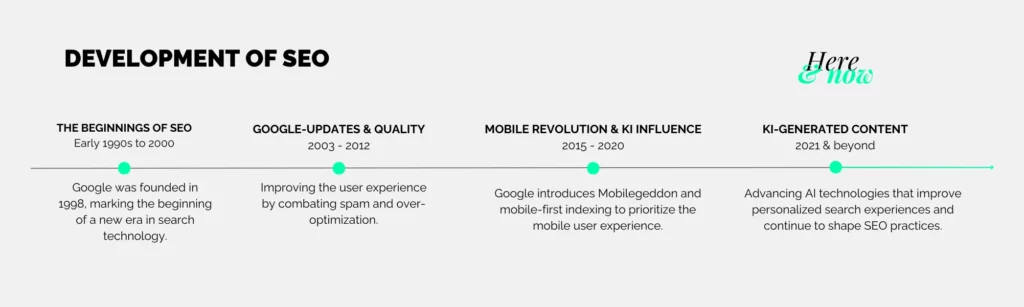
Google’s approach to AI content has changed significantly over time. Initially, Google viewed such content skeptically and tended to classify it as spam. This view reflected the fear that mass-produced, automated content could affect the quality and relevance of search results. Over time, Google has adjusted its position and recognizes that the value of content does not necessarily depend on how it is created. Google’s current stance emphasizes the importance of content quality over production method. Google measures the value of content based on its usefulness, accuracy and user-centricity, regardless of whether it was created by humans or machines. This development underscores the need for online marketing agencies to focus on creating high-quality, relevant and engaging content that meets the needs and interests of their target audience.
To go deeper into the development of Google’s approach: The progressive integration of AI content challenged Google to rethink its evaluation criteria. This reassessment reflects a fundamental recognition of technological developments and their potential. Google recognizes that AI content, when used correctly and carefully vetted, can offer real added value. This underlines the importance of authenticity, contextuality and user engagement as key indicators of quality. SEO agencies need to ensure that their content meets these criteria to succeed in dynamic SEO.
Transparent labeling
In terms of ethical considerations and transparency, it is crucial that online marketing agencies ensure that users know when they are consuming content created by artificial intelligence. This promotes trust and brand integrity. Labeling AI content should be a deliberate practice to enhance the user experience and address ethical concerns.
Continuous training and adaptation to new technologies
In addition, continuous training and adaptation to new technologies is crucial for SEO experts and content creators. Not only should current best practices be followed, but future-proof strategies should also be developed. This enables agencies to maintain the integrity and added value of their online presence in the long term and successfully meet the challenges of evolving technologies and Google updates.
Quality criteria from Google
Google uses complex algorithms and analyzes user interactions to evaluate content, with brand awareness serving as an indicator of quality. Despite technological advances, distinguishing between good and excellent content is an ongoing challenge. This reality emphasizes the importance of a mature content strategy that goes beyond keywords and provides true value. Successful content is characterized by relevance, user engagement and providing answers to user questions. This requires a comprehensive understanding of the target audience and their needs.
In order to shed more light on Google’s quality criteria, it is important to understand that Google does not only evaluate content according to its relevance or the inclusion of keywords. The search engine attaches great importance to the user experience. This is reflected in various factors such as the time spent on a page, the bounce rate and the interaction rate. Equally important is the provision of content that has a clear intention and answers users’ search queries precisely. Google attaches great importance to the authenticity and authority of published content, with external signals such as backlinks from trustworthy sites playing a role. In this dynamic evaluation process, machine learning and artificial intelligence play a central role in constantly evaluating content and optimizing search results.
AI content and SEO strategies
Adaptation to Google’s guidelines
For online marketing agencies, it is essential that their AI content meets Google’s quality standards. This means creating content that is not only optimized for search engines, but also offers real value to readers. It’s about finding the balance between optimizing for keywords and providing informative, engaging and useful content. Agencies need to continually keep up with Google’s latest guidelines and adapt their strategies accordingly. Ensuring that their content improves visibility in search results while providing value to users.
Long-term SEO strategies
Investing in high-quality content is crucial for long-term success in Google’s search results. High-quality content that addresses the questions and needs of the target group strengthens the credibility and authority of the brand. Long-term SEO strategies require ongoing optimization and updating of content to keep up with Google’s changing algorithms. This includes taking into account new technologies and trends in the field of artificial intelligence to create innovative and relevant content. This should appeal to both users and search engines.
How does our online marketing agency deal with this?
The effective integration of AI content into content marketing strategies offers an excellent opportunity to increase visibility and effectiveness. However, this requires continuous adaptation to Google’s changing guidelines and algorithms. ONELINE and similar agencies face the challenge of not only mastering current SEO practices, but also anticipating future trends and integrating them into their strategies. The key to success lies in creating content that offers real added value, improves the user experience and at the same time meets the technical requirements of search engines.
AI account tips and strategies
To optimize the use of AI-generated content for SEO, it is crucial to proceed strategically and thoughtfully. Here is a detailed elaboration of the process:
1. Keyword research
The basis of every successful SEO strategy is sound keyword research. The aim is to identify subject areas that not only have a high search volume, but also represent a niche. This keeps the competition manageable. Use tools such as Google Keyword Planner, Ahrefs or SEMrush to find relevant keywords that can offer the target group real added value. It is important to remember that it is not only the search volume but also the search intention behind the keywords that appeals to the target group.
2. AI tools for content creation
With the keywords identified, AI content creation platforms can be used to generate drafts or full articles. These tools can help to efficiently create content that is thematically relevant and aligned with the selected keywords. It is important that the generated content is not accepted without review. Human revision is essential to personalize the texts, make them appear more natural and ensure that they meet the quality requirements.
3. Optimization for relevance and reader-friendliness
Once the AI content has been created, it is important to optimize it for relevance, reader-friendliness and SEO. This includes ensuring that the content is clearly structured, contains subheadings and responds to reader questions. The text should also contain internal links to related content on the website and, where appropriate, external links to trustworthy sources. The language should be simple and understandable in order to appeal to a broad target group. Meta descriptions and title tags should be optimized to increase the click-through rate in search results.
4. Regular updates and user feedback
We are in a constant state of change, and so are the interests and needs of the target group. It is therefore important to regularly update and improve content. Using user feedback, user interaction analytics and content performance measurements to identify areas for optimization can help. Comments and feedback on the website or on social media can provide valuable insights into which topics are particularly well received. This makes it possible to tailor content even more precisely to the needs of the target group.
Challenges and solutions
Integrating AI content into the content strategy promises efficiency and scalability, demands authenticity and personalization. Human revision is essential to adapt AI designs to the brand voice and insert personal elements that create a deeper connection with the target audience.
User feedback plays a key role in tailoring content to the needs of the target group and increasing their engagement. The relevance of content can be increased by analyzing feedback. Personalization based on user preferences increases the impact of the content.
Storytelling adds authenticity to AI content by incorporating real experiences that resonate and build brand loyalty. Continuously training AI models with new data and user feedback improves the creation of personalized and authentic content. These approaches ensure a balance between automation and humanity to foster authentic connections with audiences.
Future outlook
The integration of artificial intelligence (AI) into content creation marks a turning point for online marketing agencies. As technology advances, a future is emerging to revolutionize content creation and optimization. Innovative tools that predict content trends and enable SEO automation are becoming increasingly important and offer online marketing agencies the opportunity to significantly increase efficiency and effectiveness.
In conclusion, the future of digital marketing lies in the intelligent combination of AI with traditional SEO practices. Online marketing agencies that drive this development forward and use innovative technologies effectively will not only strengthen their position in the market, but will also permanently change the way we create and consume content.