


Why bother with Google Analytics 4 at all?
Marketing decisions should always be made on the basis of sound data. The evaluation of visitor numbers to landing pages or individual subpages of a homepage can be carried out using various tools, Google Analytics being one of the best known of its kind. The big advantage: Google’s data analysis and evaluation makes it possible to establish a direct connection between marketing measures and the ranking of the world’s most important search engine.
With Google Analytics 4, we have the latest version of the analysis tool to choose from. The tool offers several innovations and special features, the correct use of which will give you a competitive advantage over your competitors. These include, for example:
- Information about activities on the website in real time
- Personalized reports that help with individual evaluations
- In-depth analyses with which you can optimize online strategy
- easy integration with Google Ads
Through the integration of machine learning and the use of AI methods, GA4 is the modern standard for page evaluation. However, real added value only arises if the analysis tool is set up correctly and used thoughtfully.
Basic information about using GA4
Whether you are an individual site owner or a web agency, there are some basic steps to take in order to use Google Analytics 4:
- A user account for GA4 must be created at Google. This corresponds to the creation of a simple Google account. If this is already available, only the website to be analyzed must be created as a new property.
- The site owner accepts Google’s terms of use and agrees that comprehensive data collection may take place around the use of his website. After this, the user follows Google’s installation instructions.
- At the end of the instructions, Google provides a tracking code. This code is to be included on the website in order to receive the first evaluations about the use of the website after only a few days.
- Since users must explicitly agree to data collection according to the jurisdiction of many countries, an adjustment of the cookie or tracking policy is mandatory after integration of the tracking code.
How a web agency helps with the use of GA4
When private users want to perform analyses of their website with GA4, they encounter two basic challenges. First, they often lack the expertise to set up the service technically correctly and effectively – including all relevant settings. In the worst case, GA4 is not adapted to the specific needs, which can lead to insufficient or even useless results. Furthermore, the adaptation to cookie policies is often overlooked, which can lead to legal problems.
Even with proper setup, there is a fundamental difficulty with any data analysis. Simply collecting relevant data does not automatically lead to an optimal strategy for future online marketing. Interpreting the data and making informed decisions requires deep insights into web marketing. This is where an experienced web agency comes into play – it is the right contact who, thanks to many years of experience, can filter trends and developments out of the collected data.
What makes the new tool so special for experts?
Google Analytics 4 (GA4) is definitely an exciting upgrade over its predecessor, Universal Analytics. Here are our impressions and conclusion about this new tool:
- Event-based tracking: The most striking feature of GA4 is the shift from page-based tracking to an event-based approach. This means that it is no longer just page views that are tracked, but also specific actions on the website such as clicks, interactions, scrolling, and so on. This enables a much more granular analysis of user behavior.
- Cross-platform tracking: GA4 provides seamless integration across multiple platforms, including web, mobile apps, and other digital assets. This enables a holistic view of user behavior, regardless of how they interact with your business.
- Event tracking without coding: A big advantage of GA4 is the ability to track events without needing extensive technical coding knowledge. Many events can be configured through the user interface, which simplifies implementation.
- Customizability and flexibility: GA4 enables deep customization of events, audiences, and reports. This gives marketers the flexibility to collect the data that is relevant to their specific business goals.
- Learning curve: Although GA4 offers many exciting features, there may be a learning curve involved in moving from Universal Analytics to the event-based mindset. New users may have difficulty finding their way around at first.
Goolge Analytics and Google Analytics 4 in direct comparison of a web agency:
Tracking-Approach
- GA: Based primarily on page-based tracking, focusing on page views and sessions.
- GA4: Relies on event-based tracking, which tracks specific actions and events on the website to provide a more comprehensive picture of user behavior.
Cross-platform tracking
- GA: Mainly focused on websites.
- GA4: Enables tracking of websites, mobile apps, and other digital platforms, providing holistic analysis of user behavior across channels.
Adaptability
- GA: Limited customization options for events and reports.
- GA4: Provides deeper customization of events, audiences, and reports to tailor data according to individual needs.
Data protection and anonymization
- GA: Has privacy features, but less focus on anonymizing data.
- GA4: Places more emphasis on privacy by providing the ability to aggregate events and use anonymized data.
Machine Learning
- GA: Uses a user interface that is familiar to many users.
- GA4: Integrates machine learning to identify patterns in user behavior and make predictions for future actions.
User interface
- GA: Focuses on goals and transactions as the main metrics.
- GA4: Introduction of a new user interface and navigation, which may take some time to get used to.
Events and conversions
- GA: Focuses on goals and transactions as the main metrics.
- GA4: Enables the definition of a broader range of events and conversions, allowing for more detailed analysis of user interactions.
Data review
- GA: Limited ability to analyze historical data after the fact.
- GA4: Enables deeper analysis of historical data by allowing events to be tracked more flexibly and specifically.
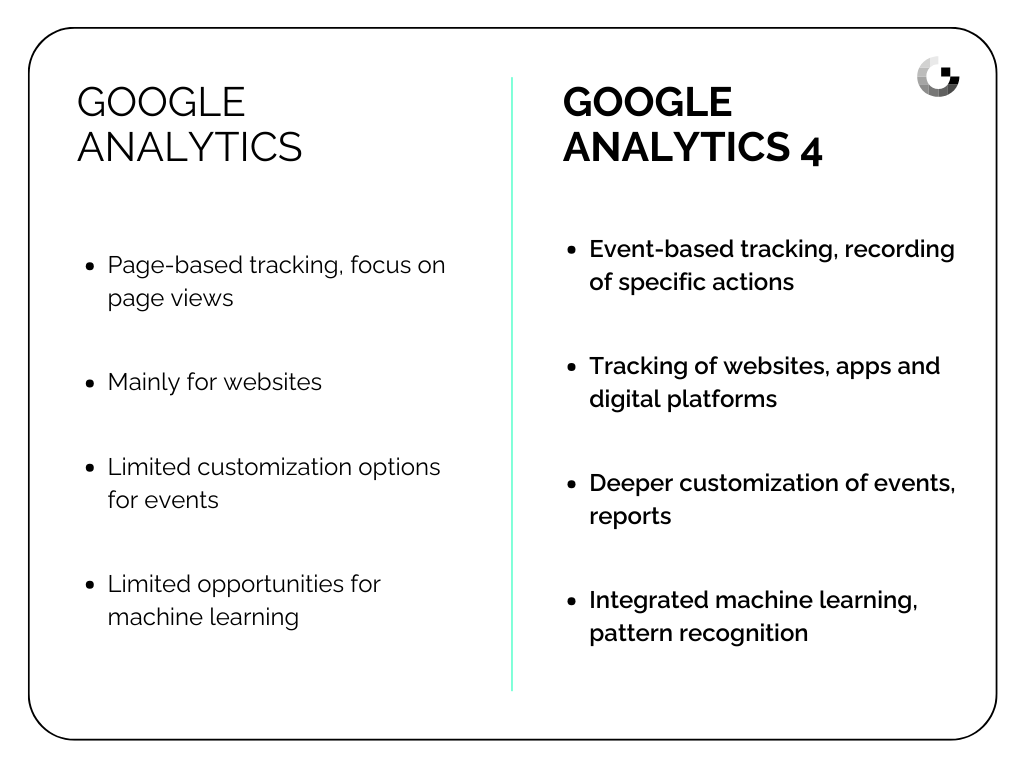
However, these are far from all the new features GA4 brings with it. Overall, it can be said that GA4 is a more modern and powerful version of Google Analytics due to its event-based nature, cross-platform functionality, privacy features, and focus on machine learning. It offers marketers the ability to gain deeper insights into user behavior and better optimize their marketing strategies.
Long-term success thanks to smart analyses
Especially in industries with great competition, even small decisions make the difference between economic success and failure. Tools like GA4 offer every site operator the potential to make these decisions based on sound data. A web agency like ONELINE can help from setting up the analysis tool to evaluating the collected data. Together with a contemporary web presence, a foundation is laid for lasting online success.