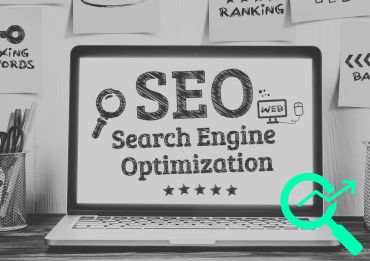


Why should small companies also rely on SEO?
The Internet is becoming increasingly important as a channel for making initial contact. Meanwhile, customers are also looking for craftsmen or hairdressers via the Internet. This means for companies of all sizes: You have to make sure that you are found by those who are looking for a suitable provider. And that’s what SEO is for.
The benefits of search engine optimization:
- Front position in the ranking of Google & Co.
- Better visibility for customers searching on the Internet
- Increased chances for potential customers to contact you
- Increased sales opportunities
- Improved online reputation
What all counts as search engine optimization?

SEO strategies are made up of many factors. This includes the creation of own content as well as the establishment of links, internally and externally. An important role for the evaluation by search engines plays the menu navigation or navigation structure of a page.
The most important SEO factors:
- Content
- Navigation/Menu
- Linking
- Technical optimization
The importance of linking
Links are a crucial SEO tool. These include, on the one hand, internal links. They help visitors as well as search engine crawlers to find a thematically meaningful path through a page. The second important link category is backlinks. Backlinks are links that direct users from third party sites to your own site.
They are enormously valuable because they give the signal to the search engines: This content is so relevant that we link to it. The more popular the linking third party site is, the higher the value of the backlink for the own SEO effect.
Content is King
Content in SEO includes all types of content: Texts, images, graphics and videos. The more unique this content is, the more valuable it is considered by Google and others. The crux: Creating unique content is costly and time-consuming. Copying other content is less expensive – search engines today can quickly expose such copies. This results in poorer ratings and a drop in the ranking. Therefore, investing in high-quality content of your own is worthwhile in any case.
How do you create appropriate content?
When planning content, the target group is the most important factor: What are readers interested in, what are they looking for? As a website operator, you should ask yourself with every text, image or video: Does my content offer the reader added value? – Can the user learn something helpful?
Popular types of content include how-to content, such as tutorials or tests. In-depth information on products is also widely read.
Keywords determine the direction of travel
The right keywords are crucial for successful search engine optimization. These are the most important keywords under which a company wants to be found. For example, if you offer a service such as coaching, you should integrate all relevant keywords in this area into your content.
Important: For the determination of the keywords, one should orientate oneself on the search behavior of the Internet users. Keyword tools are available for researching suitable keywords and their search volume.
The preferences of the target groups should be taken into account when choosing keywords. A hair salon, for example, can focus its content on products or lifestyle topics. If you want to address a young lifestyle-oriented audience, you should rather go in the direction of trend content. If you want to attract brand-conscious customers, you focus your content on branded products.
What can be done technically for the SEO effect of the website?
The CMS and the structure of a page decisively determine how smoothly readers and search engines can move around the website. Therefore, page operators should remove all hurdles and ensure an intuitively understandable structure. A sensible hierarchy is important for menu navigation: subpages must be sensible subitems to pages above them.
For example, these can be individual product pages that are arranged one level below matching category pages. Important to note: The relevant keywords should be found as often as possible in the page titles.
Page speed analyses help to optimize the technology of a website. They show whether there are technical obstacles in the system for fast navigation through a website. Such obstacles can be, for example, large files that are completely loaded when a page is displayed and slow down the page load.
Note: Today’s Internet users are used to surfing within seconds – and punish slow page loading by bouncing. Search engines punish long loading times by downgrading the ranking.
What is the cost-benefit ratio for SEO?
For search engine optimization to be effective, investments in SEO measures are necessary. These costs are amortized by the effectiveness. A higher Google ranking means more contacts by potential customers. Those who run a webshop even feel an improved ranking directly in the increasing sales figures.
Conclusion: You can’t do without SEO
Today, people search for products and services almost exclusively via the Internet. There, the competition for the customers and prospects is getting bigger and bigger. To be visible, not only large companies but also small businesses need to develop search engine optimization strategies. Properly implemented, both the initial investment and the ongoing costs for search engine optimization pay off.