


Accessibility: What is meant by “accessible”?
Accessibility describes the accessibility of the web design and content on a website. It is necessary to align the design process in such a way that everyone can use the website. The aim is to ensure that people with disabilities can also reliably access the information.
Definition
Accessibility refers to the design of environments, products, or services that are accessible and usable by all people, regardless of their individual abilities or limitations. In the context of the Internet, accessibility refers to the creation of websites and digital content that are accessible and usable by all users. An accessible website takes into account the needs of people with different disabilities and enables them to perceive and use the website’s content. The term “accessibility” is defined in the European standard EN 301 549. According to it, websites must be easy to use, robust, understandable and perceptible. The goal of accessibility in web design is to create an inclusive environment for all users and to avoid discrimination based on individual limitations.
Challenges and problems
Web design accessibility is intended to help people with disabilities access existing content.
- Intellectual limitations range from limited cognitive abilities to learning disabilities. Media barriers and perceptual barriers are particularly critical.
- Physical limitations include motor limitations and impairments in hearing, speech, or vision. They result primarily in physical barriers.
- Mental limitations can be neuroses, psychoses or personality disorders. Here, perceptual barriers or systemic barriers can be particularly problematic.
Laws and guidelines
To date, the legal guidelines on accessible design only apply to public bodies, state-related companies (SBB or the Post Office) and public institutions such as universities, schools, hospitals or libraries. The following ordinances are of particular importance:
- In Switzerland: the eCH-0059 Accessibility Standard
- International: the Web Content Accessibility Guidelines (WCAG)
- In the EU: the EU-Richtline 2016/2102
Accessible web design: What is it?
Digital accessibility refers to different aspects of the design of websites. Because although the Internet is basically open to everyone, not all people can access all content. For this reason, the World Wide Web Consortium (W3C) has developed the four principles of accessibility.
Each of these aims to ensure that digital content is available to everyone. The basis for this is, for example, textual alternatives, a responsive design, high-contrast displays and the consideration of color weaknesses.
4 principles of accessibility
- Usability: The control elements are selected and designed in such a way that every user can use them.
- Robustness: The content can be grasped with technical aids, such as a ReadSpeaker.
- Comprehensibility: Navigation and operation are simple and intuitive. Content and images are understandable and offer the desired added value.
- Perception: Information is immediately recognizable as relevant content. To this end, they appeal directly to at least one sense.
These 4 principles of accessibility form the basis for accessible web design. A good example of an accessible website is therefore a website that can be used by blind or visually impaired people. At the same time, such a design works on very large monitors, but also on small smartphone displays.
Web design and accessibility: why accessibility is so important
What exactly does accessibility mean on the Internet? This question is central when it comes to understanding the importance of accessible web design. Accessible websites function flawlessly on different end devices and thus support usability. At the same time, accessibility also enables physically or mentally impaired people to access the available content. In addition, accessibility offers further benefits:
- The reach of websites increases because Google’s algorithm considers accessibility as part of usability. This gives the website a better ranking and makes it easier to find.
- In general, usability improves for all site visitors. The reason for this is intuitive and simple operation, but also a clear added value thanks to high-quality prepared content.
- Accessible content appeals to more people, which expands the target group.
- An accessible web design makes an important contribution to social responsibility.
Accessible web design: How it works in real life
For accessible web design to succeed, special expertise in web development is required. But despite the additional effort, accessibility is one of the absolute must-haves of any website. To create such a web design, it is advisable to use common tools. Moreover, one should adhere to the “best practices”.
Programs and tools
The cost of a good web design can increase due to the flawless accessibility of a website. Nevertheless, this investment is worth it, as it represents a long-term gain. Various tools can be used for this purpose:
- Content management systems (CMS) such as WordPress also provide accessible web designs. Here it is worthwhile to take a look in advance at what the providers offer and the implementation options.
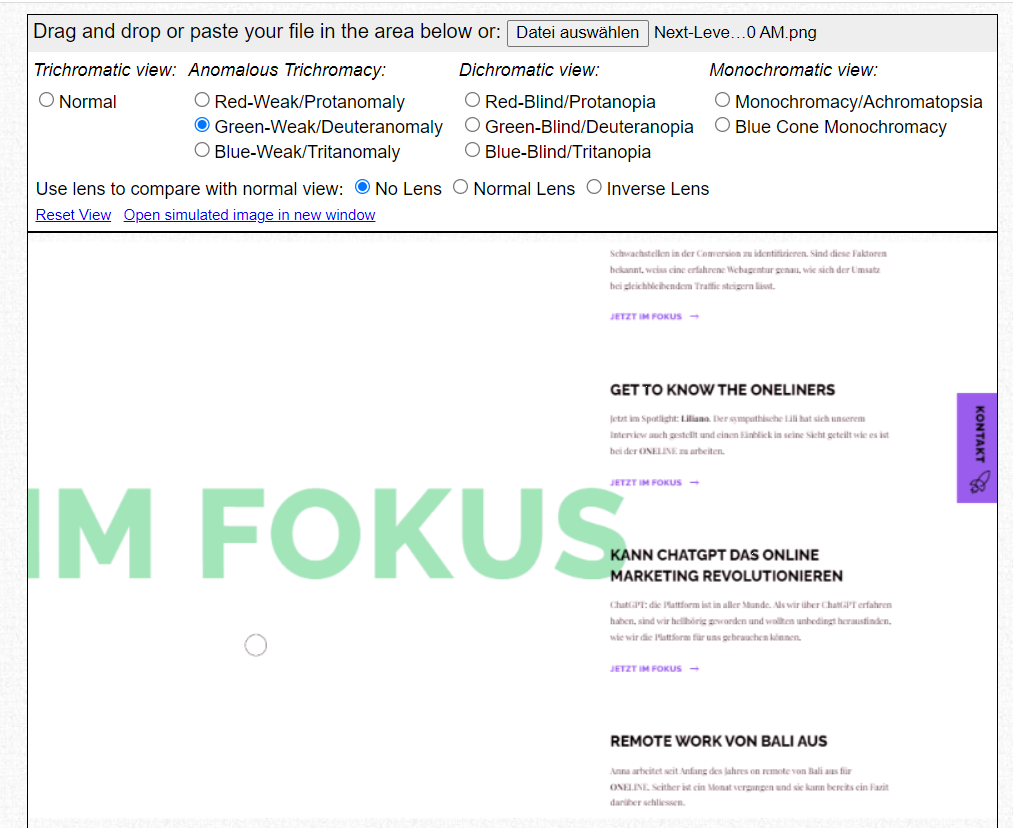
- Coblis is one option for simulating color vision deficiencies and displaying the web design accordingly.
- A LanguageTool also helps to test an accessible web design. Here the focus is on whether texts are easy to understand.
- Contrast calculators check the contrast ratio and thus the accessibility of a website and the selected color combinations.
- Integrating a ReadSpeaker is an efficient step towards accessible web design.
Practical tips
For a professional web design to be convincing, it must be accessible, among other things. Therefore, there are extensive guidelines that deal with the topic in detail. In addition, the following tips help to implement the accessibility of websites:
- Adhering to the hierarchy of headings provides a neat structure and makes texts easier to read.
- It is important to correctly reflect the page title in the title attribute.
- Regular validation of the HTML helps to ensure that the web design is displayed as desired in all browsers. It does not matter whether the website was created with WordPress, Typo3 or another CMS.
- Sufficient contrast between background and text is necessary to improve readability.
- A responsive web design is important to display the website on different sized devices.
Conclusion: Creating accessible websites – very easy, with the right support
Accessible web design is a challenge in itself. However, with the right partner, it is possible to successfully overcome this hurdle. The result is a legally compliant web design that appeals to all people equally. As an experienced web design agency, we at ONELINE know what it takes to increase the accessibility of a website and offer users real added value.
Apart from that, content marketing, display marketing, placing advertisements (Google Ads) and search engine optimization (SEO) also fall within our range of services.