

The future of online marketing
The demands on online marketing managers are becoming more and more stringent. Furthermore, legal requirements, digital developments and increasingly critical customers make online marketing a discipline that thrives on constant development. Without the personal willingness to learn, this will not succeed. So that you can place targeted advertising in online media for your company and use the full advertising effect. Let us inform you now about the online marketing trends of the future. Our online marketing agency will present them to you in more detail.
The following trends will play an important role in online marketing in the future:
- Tailor-made content
- Old tools rethought.
- Creativity wins target groups.
- Target group segmentation.
Tailor-made content for your online success
High-quality and well thought-out content will play an increasingly important role in the work of an online marketing manager in the future. Google’s strict focus on well-researched text contributions in online media and the accompanying evaluation of these contributions already set the trend. In addition to high text quality, the personalisation of advertising texts also plays an important role. Moreover, online advertising has to meet the expectations of the target group in the area of image and text and has to have its finger on the pulse of the times. This presupposes that you know exactly what your target group wants and desires. Only then can you transform your products and services into tailor-made content and make them available to your target group to read. By the way, already today the success of personalised advertisements is 6% higher than that of conventional advertisements. Conversely, this means that readers of personalised advertisements become payable customers more quickly. Use the advantage!
Old tools rethought: understanding marketing formulas and applying them correctly
The core of marketing has actually not changed that much in the past decades. Advertising still relies on strong images and texts. In addition, you can still use tried and tested formulas for everyday work. Our online marketing agency will introduce two of these formulas to you in detail. These are the AIDA advertising effectiveness formula and the PAS advertising text formula.
AIDA model after Elmo Lewis
The AIDA formula is regarded as the best-known instrument for explaining the advertising effect. The words behind the term are: attention, interest, desire and action. The formula dates back to 1898 and is today more topical than ever. Our online marketing agency now explains the popular advertising effect formula using a short example:

- Attention: The first step in marketing communication with your target group is to get their attention. Without attention, all the marketing budgets you invest in the future in the distribution of your products and services will go up in smoke. The challenge here is to stand out from the crowd, to make an impact despite the sensory overload.
- Interest: The second step is to deepen the attention of your target group. Ensure that your products and services are firmly anchored in the memory of your target group.
- Desire: The next step is to transform the interest in buying into a desire to buy. The respective advertising messages must address the emotional emotional level on the one hand and the cognitive level on the other.
- Action: If all the previous steps have been used sensibly, the last step requires an invitation to take action to buy the product or service. In online marketing, “call-to-action” continues to play the decisive role. Depending on the target group, however, influencer marketing is also an effective method of arousing interest in buying.
The four steps will help you to plan online marketing campaigns and to set up concrete advertisements. Combine them with the PAS formula and profit from the structured and clear procedure.
PAS formula for effective sales texts
Behind the PAS formula are the words: problem, excitation and solution. The well-known advertising text formula aims to attract the reader’s attention. This is achieved by offering effective solutions to customer problems that make everyday life easier. In this way you create real added value! First of all, you address the problem. Show the reader some worst case scenarios. By playing up the problem, the excitement of the reader increases. To activate the emotions. Now you offer the solution.
This lies in the advantages of its products. By placing problems visibly in the headline, you get the reader’s attention. Curiosity increases through a short, crisp introduction that explains the problem in a targeted manner. Now one gets to the core of the problem and uses the emotionalisation. Now the added value for the customer lies in recognising products as the problem solver. Underline the effect by emotional pictures or videos. The PAS formula has proven itself in the past and will continue to play a role in the future. Try it out!
Creative advertising wins – yesterday, today and in the future
How on earth can you stand out from the crowd when two million contents are produced every day? Clearly with quality, which, as so often, is demonstrated by creative, eye-catching advertising. That’s why companies are looking for real creative minds for online marketing jobs. With their clear sense for the needs of target groups and trends, they should be able to create tailor-made advertising. But in the stressful everyday life it is often not easy to call up the creative potential in you at any time. What can help you? Retreats within the company – which give the necessary freedom for creative thinking and the use of creativity techniques.
With creativity techniques, become more creative!
Creativity techniques are methods that aim to solve problems effectively by generating new ideas. Use a bundle of characteristics is such as knowledge, skills, environment, personality, motivation and talent. There are two creativity techniques methods: Intuitive and discursive. You work either in a team or on your own. Depending on the size of the company. Both methods basically help you to structure and clearly define problems.
Intuitive creativity methods give you many different ideas in a very short time. They are mainly designed to activate your subconscious. Some of the best known methods are: Brainstorming, mind mapping, ABC lists, metaplan techniques but also creative writing, the idea marathon or the 6-3-5 method.
Discursive creativity methods proceed more systematically. In the rules they last 30 minutes. After that you should have 10 to 50 new ideas available. To get to the ideas you split the actual problem into small units. This way the problem is completely described and opens doors for different approaches to solve it. Among the best known methods are the following: Morphological box, relevance tree box, Osborn check list, progressive abstractions or the force field analysis.
Latest approaches combine both creativity methods. For example, try De Bono’s thinking hats or find out about the Walt Disney method, value analysis, the BarCamp or the Future Workshop. This goes back to the German futurologist Robert Jungk and is often used in companies today.
Target group segmentation becomes the norm
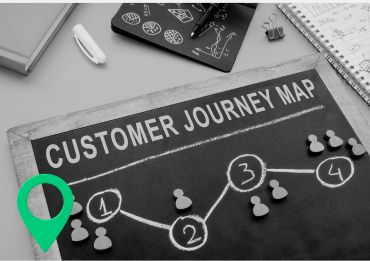
In the previous sections, you have read that personalised marketing can help you to win customers in the future. The benefits are obvious: generating conversions, a better customer experience and increased ROI. But before all these visible successes lies the real task – the segmentation of your target group. Without the clear demarcation of target groups, you will not achieve success with any of the methods. You need to know which target group buys your products and services. Probably the most elementary building block in marketing if not in the entire company.
In order to be able to provide advertising on the internet that fullfill the needs of your target groups, you must first determine them. Target group segmentation helps you do this. It introduces you to your target group in individual steps. This target group consists of your potential customers, who are basically similar in their attitudes, needs and interests. In this way, you can also find out which people will not buy your offer.
First of all, the total market is divided into individual buyer groups. These include demographic, geographic and behavioural criteria. In the second step, you analyse the user behaviour on your website and social media platforms. These results are also incorporated into your target group segmentation and provide you with valuable information for your future marketing strategy.
Sinius Milieus
During your work you will sooner or later come across the concept of Sinius Milieus. The Sinius model originally refers to the German population. It was developed in the 80s by Sinus Markt- und Sozialforschung. The research group divides different social strata, the milieus, into target groups according to value concepts and similar attitudes to life. Sinius milieus now exist for many other countries. Classifying one’s own target group on the basis of Sinus Milieus is still one of the most frequently used methods today. It is highly effective and easy to understand. The creation of personas completes the work of target group segmentation.
Do you need support with the complex target group segmentation? Please contact our online marketing agency. Together we will determine your target group. Afterwards we create the marketing strategy for your future success in online marketing.
Our conclusion on the topic: The future of online marketing
Online marketing is subject to constant change. The focus is on the behaviour of your customers. In order to be able to pick up new trends in personalised advertisements, you need to continually educate yourself. As a loyal reader of our blog, you will have your finger on the pulse of time and never miss any news concerning online marketing. Always focus on creative solutions and high quality content. Do you have questions concerning online marketing? The team of our online marketing agency will be there for you in the future too. Motivated, they research trends and keep the big picture in view. You need advice – then contact us now!