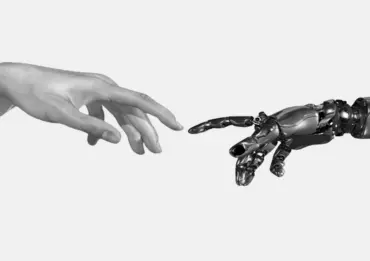


A tool. This represents a complex and at the same time intelligent machine learning system. Why complex and intelligent? Because this helpful tool has the ability to create different types of written content. However, in order to compete with presentable content marketing, the AI had to rely on a long learning process. One trillion words were appropriated by the system. Is that why GPT-3 really expresses itself like a human being? Will it replace content writing in the near future? To answer these questions, the SEO agency ONELINE analysed the future-oriented tool system. It is worth pointing out the current status of the translation machines. After all, they prove how far the state of AI has come.
Doch, um mit einem vorzeigbaren Content Marketing zu konkurrieren, war die KI auf einen langjährigen Lernprozess angewiesen. Eine Billion Wörter eignete sich das System an. Drückt sich deshalb GPT-3 tatsächlich wie ein Mensch aus? Ersetzt es in einer nahen Zukunft das Content Writing? Um diese Fragen zu beantworten, analysierte die SEO Agentur ONELINE das zukunftsorientierte Toolsystem. Dabei lohnt sich der Hinweis auf den bisherigen Stand der Übersetzungsmaschinen. Immerhin beweisen diese, wie weit der Stand der KI mittlerweile ist.
GPT-3 is a language processing model developed by OpenAI. The tool uses Deep Learning to compose, simplify, summarise or translate texts. OpenAI is an American non-profit organisation founded in 2015 by Elon Musk and Sam Altman, among others. The goal of this NPO is to research artificial intelligence and make the results available to the public. In the long term, OpenAI aims to develop a human-like artificial intelligence.
Machine translations show the way
Translation tools have demonstrated what nobody would have thought possible: They not only translate short, simple sentences from one language to another, but also complete websites. The developers are also working on improving the systems. At the moment, however, machine translation is not a threatening competition for translators and interpreters. There are several reasons for this. Firstly, a language is constantly changing: new expressions are added, such as Covid. For another, there are many different translation possibilities, which is why errors creep in. Sometimes nonsensical translations arise. This is especially true for sentences that contain a subjunctive. Translation tools provide proof that AI reaches its limits and is only useful to a certain extent.
So what about GPT-3? Does this system score with other advantages? According to experts, a minimal request is enough to replace content writing that is meaningful in terms of content and grammatically correct. At first glance, these texts look deceptively real. Unless they contain errors, they are no different from the articles of a human writer. What does this development mean for the future? ONELINE clarifies.
Is GPT-3 better than the human being?
Do people who earn their living with content writing have to look for a new professional activity? Does GPT-3 exceed human abilities? These questions can certainly be answered better after a detailed presentation of the AI system. Therefore an explanation of the capabilities of the AI tool is given.
- 175 billion parameters
- 96 layers
- 100 times larger than its predecessor GPT-2
- 10 times larger than the competing product Turing-NLG from Microsoft
And how did this tool learn? Where do its skills come from, which can be compared to the writing skills of an author? The “skills” and “knowledge” of the AI system come from specific training. More than 570 gigabytes of text files served as the basis for training. These originate from different data sets: WebText, Common Crawl, book data sets Books1 and Books2, as well as the English Wikipedia page, served as a learning basis. It sounds as if authors, copywriters, writers, ghostwriters and copywriters could start retraining.
Fortunately, the reality looks different. Translators and interpreters are still in demand, even though AI sometimes delivers high-quality translations. Often automated text translations deliver nonsensical, useless and strange sentences. This is due to the shortcomings of translation tools. Obviously, the human brain performs more complex tasks. The same is true of GPT-3. The system has so far only written article texts. It can write simple texts, but it has significant shortcomings. Even the developers of GPT-3 affirm that this system only provides an insight into the potential of AI systems.

AI vs. humans
One reason why AI tools may be able to compete with humans in the distant future is their learning behaviour. They have the basic knowledge. However, few, additional tasks are sufficient for AI systems to expand the basic knowledge acquired. But if the AI sentence construction has to compare with each other, it weakens. GPT-3 has three major shortcomings:
- It does not recognise whether the same word has the same meaning in two sentences.
- Is a phrase a paraphrased sentence? GPT-3 does not recognise any difference.
- Does one written sentence imply another? GPT-3 is overwhelmed by this question and gives up.
The top 3 services of GPT-3
Authors, copywriters, writers, ghostwriters, journalists, copywriters and content marketing agencies who want to know whether GPT-3 replaces content writing should read a work: A text written by the AI system. In this way, readers can gain insight into the brain of GPT-3.
- GPT-3 clearly displays incomprehensible tweets with the help of an extension. Jesse Szepieniec had difficulty understanding a tweet. Therefore he asked GPT-3 for help. He inserted the text into the tool, generated and optimised the tweet before he enjoyed the 95% extension of the original tweet.
- The AI tool acts as a clever software engineer. It writes functional codes from simple English input.
- Top blog articles thanks to GPT-3? Sounds incredible, but it’s true. In the USA, a student created an article using GPT-3 and got a top position in the hacker news. The crowning glory: Only a small number of readers realised that this post was by no means written by a copywriter, but definitely an AI system. Nevertheless, numerous users discussed the blog post.
Does GPT-3 promote the end of the blogging era?
Since the AI system has a decent basic education, it writes high-quality blog articles. The structure is characterised by logic, the grammar contains no mistakes. However, small things need to be changed, after all, the AI is writing this text. According to experts, the number of blog posts will increase many times over thanks to the further development of AI systems. Blog sites fearing for their existence will resort to GPT-3 in order to continue to assert themselves against the competition. Blogs that are successful in a niche topic will use AI to fill their articles with long-tail keywords. This gives them an edge over the competition.
Even though GPT-3 matches the skills of an author in some respects, this system does not replace a qualified copywriter. Content writing is based on logically structured, well-thought-out, high-quality, and unique texts. Stringing together words is out of place. Furthermore, search engines have a so-called say in the matter. Fortunately! Because internet search engines do not “like” artificial texts that do not offer added value to the readers. Is there any tangible proof of this? Yes. The well-known keyword stuffing has proven that not only Google but also other search engines “think along”. They punish texts that are characterised by keyword spamming by not displaying them. Articles that have a high keyword density sound artificial. Moreover, they offer no additional benefit. Therefore, Google will in the near future take a closer look at the texts and ban articles written with the help of AI.
The ethical use of GPT-3 for successful content writing
A content creator who relies completely on GPT-3 for text creation must expect penalties. It is unethical to use the tool and outsource all the work. Passionate copywriters who love their work, on the other hand, use GPT-3 ethically. They rely on AI to use their time more wisely. This saves them hours of surfing and time-consuming research for information. Instead, they maximally optimise the texts written by the AI. Partner in crime – that would be the correct term for “sincere” authors. After all, dictation systems also provide valuable support, making the everyday work of a copywriter easier. However, they do not relieve him or her of the task of writing articles.
However, ethics does not play a major role. Instead, a good conviction dominates. Man has always been interested in the original thoughts of his fellow human beings. Regulation of words, however, have a bitter aftertaste – for intellectual development. They do not provide the mind with a “healthy choice of words”, but with mixed-up sentences. In the long run, this method is doomed to failure without human effort. Critics call AI systems that are asserting themselves as authors plagiarisms, which go the “man-on-machine” way.
People have prejudices – GPT-3 also
GPT-3 learns like a human from systems that humans have developed. However, as the vast majority of people have prejudices about many things, people or cultures, this also applies to GPT-3. Therefore, users who rely on AI systems as authors should strictly control their content – to avoid image-damaging prejudices.
GPT-3 requires responsible use
GPT-3 scores with its high performance. For bloggers, it is a useful addition and practical relief. Journalists who work with their classic W questions or authors who convey a certain message to their reader’s boycott AI systems. In the end, they degrade their highly qualified work. But as soon as they discover the positive aspects, copywriters and online marketing agencies will also use the advantages to polish up their articles. Thus GPT-3 secures a place in the future of content marketing. However, the tool is not the monopolistic future of content creation. Automated translation tools have proven that a human, intellectual activity is irreplaceable, at least until today.
Why GPT-3 will not replace content writing
Readers love texts that offer them added value. Although information plays a major role, the power of emotions should not be underestimated. Authors rely not only on information when writing their articles, but also on the power of emotions. They use words in a targeted way to make their readers think or rethink. The age and life circumstances of the readership play a decisive role in this. In this respect, the human way of thinking eradicates artificial intelligence. Because a captivating text is not only informative but also empathetic and emotional.